

Any health care funding plan that is just, equitable, civilized
Any health care funding plan that is just, equitable, civilized and humane must - must - redistribute wealth from the richer among us to the poorer and the less fortunate. Excellent healthcare is by definition re-distributional.
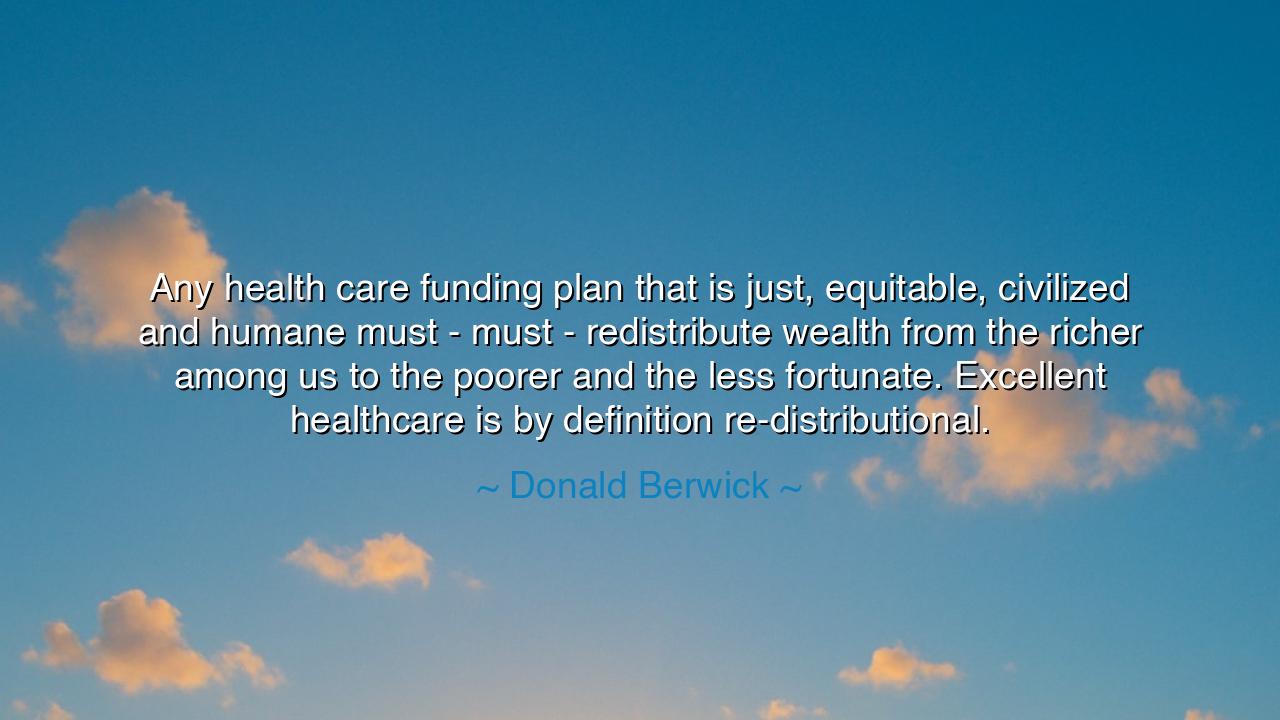










Hearken, O children of generations yet unborn, and attend to the words of Donald Berwick, who spoke with clarity and moral urgency: “Any health care funding plan that is just, equitable, civilized and humane must — must — redistribute wealth from the richer among us to the poorer and the less fortunate. Excellent healthcare is by definition re-distributional.” In these words lies a meditation on justice, compassion, and the moral architecture of society, a truth as enduring as the teachings of the philosophers and lawmakers of antiquity.
Consider first the principle of justice in caring for the vulnerable. Berwick declares that health is not a privilege to be hoarded by the wealthy, but a right to be extended to all. In ancient civilizations, rulers who hoarded resources while neglecting the weak sowed discontent and instability. The wisdom of Solon in Athens, who enacted reforms to protect the poor and limit the excesses of the rich, reminds us that society thrives when fairness guides the distribution of essential resources.
The phrase “just, equitable, civilized and humane” evokes the moral imperatives that underpin governance and community. To be civilized is to recognize that the measure of a society is not in the wealth of its elite, but in the care it provides to the least among its members. The ancients understood that neglect of the vulnerable imperils both morality and stability. Berwick’s insistence upon redistribution underscores that healthcare cannot be divorced from fairness and ethical responsibility.
Berwick also emphasizes that excellent healthcare is inherently re-distributional. Medicine and care are not simply technical exercises but moral acts: providing access to the poor and less fortunate ensures both societal cohesion and human dignity. History bears witness: during the Black Death, those communities that organized care and shared resources survived more resiliently, while those that hoarded aid suffered catastrophic losses. Justice in health is a shield for both the weak and the common good.
Consider the story of Florence Nightingale, whose tireless work during the Crimean War and afterward improved care for the sick and wounded regardless of rank or wealth. Her reforms were predicated on the principle that access to care must extend to all who require it, not merely those who could afford it. Berwick’s words echo this ancient truth: morality and efficacy in healthcare are inseparable from equitable distribution.
From this reflection emerges a timeless lesson: prosperity and health are intertwined with justice. Societies flourish when the strong and wealthy contribute to the protection and care of the vulnerable. Berwick reminds us that equity in healthcare is not charity alone, but a moral and practical foundation for civilization itself. The well-being of the many depends upon the willingness of the few to share resources, insight, and responsibility.
Practical action flows naturally from this wisdom. Advocate for policies that ensure access to care for all, support programs that redistribute resources equitably, and encourage communities to recognize their shared responsibility for health. Invest time, wealth, or effort to safeguard the less fortunate, knowing that justice and compassion are the true measure of a society’s strength.
Finally, remember the eternal truth: civilization is judged by how it treats its weakest members. Donald Berwick’s words are a clarion call: redistribute not out of pity, but out of justice; care for the vulnerable not as obligation alone, but as a sacred duty, for in doing so, society is strengthened, dignity is preserved, and the promise of humane and excellent healthcare is fulfilled.
If you wish, I can also craft a narration-ready version of this reflection, with rises and falls that emphasize both the moral weight and the heroic vision of Berwick’s insight.

AAdministratorAdministrator
Welcome, honored guests. Please leave a comment, we will respond soon